
Nicaraguan Archives
A reflection on a most serene stay in one of my favorite places.
In 2013, my family invested in property in Nicaragua.
I spent many of my college breaks at the beachfront home on the country’s west coast; mindless weeks at a time staring out to the Pacific Ocean breaks, baking in the equatorial sun and appreciating the simple life.
In 2018, I extended my stay to explore the country outside of the typical beachtown bubble. I was on assignment for the magazine I worked for and spent a few days inland at farmstays as well as an independent lakefront ecolodge built by local craftsmen. The calm at the latter was so profound that I still remember the feeling eight years later. I also vividly remember browsing flights in an attempt to hideaway a little longer.
At the time, I was living in NYC and the primitive escape, surrounded by pure silence felt like the biggest luxury.
I don’t know what sparked it, but a few weeks ago, I felt nostalgic for Nicaragua. I was flipping through old notebooks and stories from the stacked time I spent there between 2013 and 2020. That’s when I stumbled upon this memoir piece I began from my trip to the boutique retreat. It was never published and as I researched a bit more, I see all these years later Isleta El Espino continues to provide plenty of opportunities for travelers to disconnect from daily life and reconnect with their inner adventurer, nature-lover, chef, or culture guru.
Here’s a snippet from my time there; my hope is that it inspires you to reminisce on a destination you love but haven’t reflected on for awhile. There’s something really special about taking time to revisit memories, destinations and of course, the words from our younger, less-jaded selves.
The saltwater splashed over the wooden motorboat as we putted our way through the tiny islands in Lake Cocibolca; Las Isletas de Granada. About 90 minutes from Nicaragua’s capital, the islands of Granada are a popular retreat for visitors in search of a more secluded, ecological experience to connect with nature and the local culture.
Amidst the various islets, that house local fishermen and craftsmen, lives Isleta El Espino; a five-room, solar-powered ecolodge created by brother-sister duo, Andrew and Kristin Werner. The unassuming property first came into sight with its recognizable yoga pergola; its palmed platform the only sign of infrastructure on an island otherwise inhabited only by reeds, palms, mango trees and jicaro plants, identifiable by their warped trunks.
The original image of the untouched island is what Andrew and Kristin discovered in 2007, upon their first trip to Nicaragua. They fell in love with the country, the people, the atmosphere, and most of all the opportunity to share their experience with so many others, and thus, bought the private island.
The first thing they did was build a dock to transport all the materials to begin construction, but the island has since transformed into a fully operating boutique hotel, preserving as much authenticity as possible from rocky pathways to local plants—and upholding that untouched appearance from afar.
I hopped off the boat to a natural trail strewn with mangos, and peered around; the common area of hammocks and wooden tables, welcomed me to something reminiscent of a remote summer camp. As the staff handed me a fresh lemongrass tea, they asked if I wished to see my room.
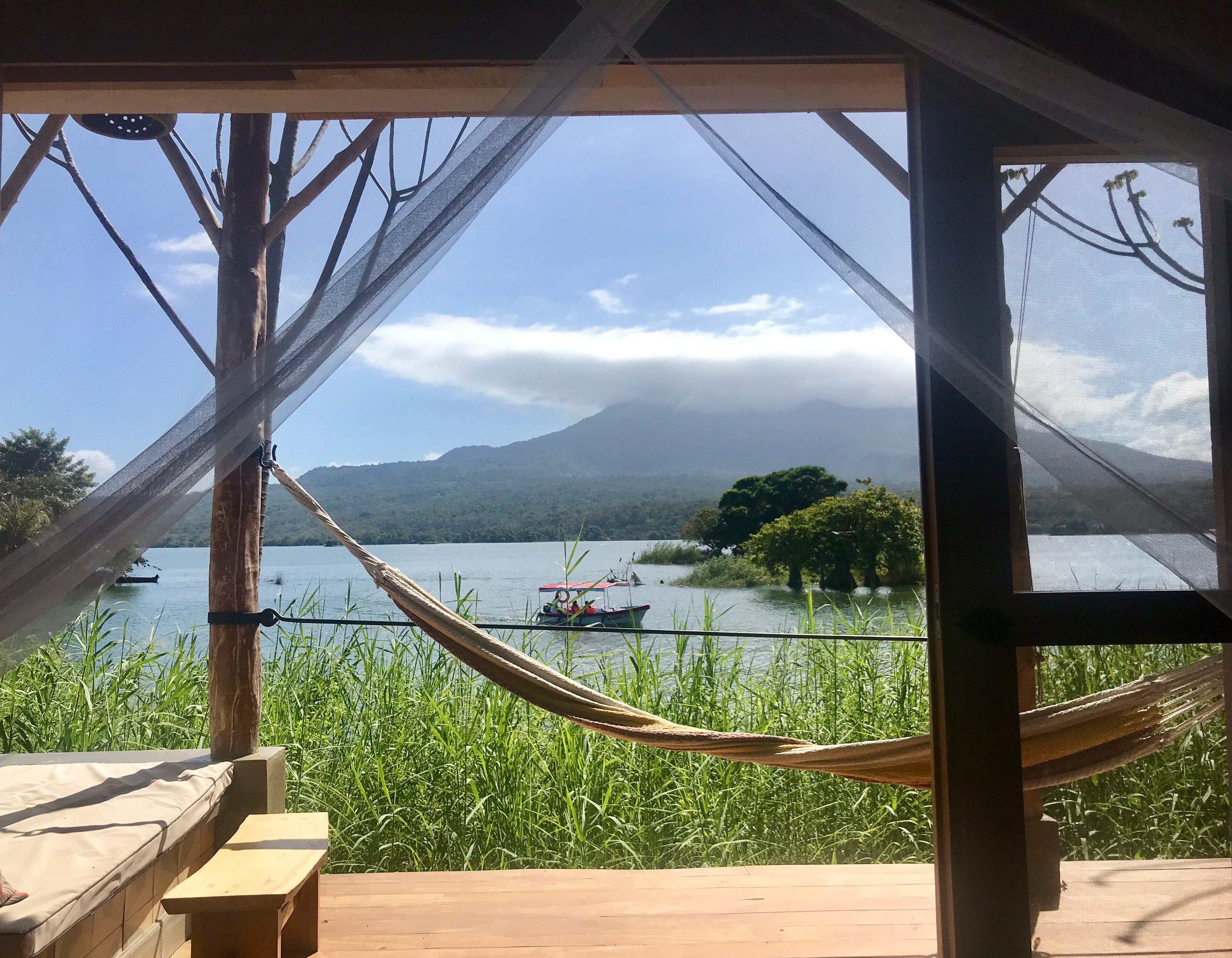
I squinted from the sun sneaking through the over brush, unable to make out infrastructure past this point. I nodded, and continued along the virginal terrain of volcanic rock to discover my individual casita, suite-style, enclosed by nature but opening up to a lake view of nearby islets with the Mombacho Volcano in the distance.
The remote blueprint of the dispersed casitas was designed in respect for the island with its longtime caretaker—he lived behind the hotel until he retired at the age of 102. For Andrew and Kristin, he was an influence as to how to create the most immersive, respectful experience for visitors, emphasizing nature and the local lake culture.
This is why each casita stands on its own, from the jungle bungalow to the treetop ranchos, to allow guests to feel like they are living in harmony with the island. The program of locally curated activities, allows guests to not just appreciate the natural surrounds, but also to appreciate local practices.


I pulled back the mosquito net framing my room’s French door and settled in—immediately noticing the craft tiles, stainless steel water bottles, and salt scrubs in ceramics, rather than an expected plastic offering. Everything felt in accordance with island living, so I lived it.
Mornings were spent watching the sunrise in the lakefront hammock, as the brisk air quickly warmed and brought life to the lake. These are also the best hours for fishing, an opportunity that Isleta El Espino offers guests to participate in; catch your own fish and bring it back to the restaurant to cook up. It was during this experience that I was able to grasp the role of net fishing on the lake; mostly used as a subsistence farming technique for its inhabitants, net fishing isn’t easy, and thus you appreciate everything—more like anything—you catch.
I was also introduced to the local production of chocolate from raw cacao, which Andrew tells me used to be the currency of the indigenous. Throughout this process, every step is taken with care, from heating the raw cacao, to cracking the shells one-by-one, to a meticulous grind and even slower melt, giving way to a deep, dark, gooey chocolate, unimagined until that moment.
“We don’t isolate our guests from local culture, we’re not all inclusive or walled off from the people of the environment, we’re all upfront,” reinforced Andrew after I tell him how much I’ve enjoyed being part of the island’s functioning day.
By employing 11 locals, including chefs, maintenance and groundskeepers—and not just Nicaraguans, but indigenous persons to the lake—Isleta supports the community, providing them with another home on the lakes, while simultaneously encouraging guests to appreciate the customs, in finding the private island as a home of their own.
Through this collaboration with locals, the ecolodge has been able to rely on the fruits of their land to produce their own ginger beer, butter, tortillas, granola and chocolate, and to create interactive opportunities for visitors to savor, but also to learn from.
Essential of the week: Remarkable Paper
As a writer, I have notebooks everywhere. For many years, when I traveled, my phone replaced paper as my handwriting couldn’t keep up with collecting the details from interviews, activities and the miscellaneous home to-dos that infiltrated my brain on the road. That is until I learned about the Remarkable tablet— and now it comes with me on all my trips to keep my notes organized.
No longer do I need to start a new notebook for every new trip I take (which only results in a quarter or half-used log that inevitably goes to the bottom of my desk drawer once I’ve referenced all I need) as the tablet and pen make it easy to record all the details — all in one place! It’s thin, holds a lasting charge, syncs with your existing Cloud accounts for back-up and I think it’s perfect for anyone who’s constantly taking notes on the job from journalists like myself to designers, architects, personal assistants and more.
Recent work:
Love destination golf but hate spending all day on the greens? These courses were designed for you.
Want to make a better margarita? Use this key ingredient.
Ever wonder why spirits taste different? It’s not just what they’re made of, it’s how they’re made.
XO,
Not all inclusive, "all upfront". Loved this. The whole piece, and the reminder to revisit "words from our earlier, less jaded selves"