

I Don't Break Promises...

As promised...
This issue is dedicated to a different experience I had while traveling that explores the difficult and darker side of tourism that isn’t always fun, nor easy, to share. Even as I sent out the last issue of Jilux, I immediately regretted holding myself accountable for having to open this conversation to a newsletter I always try to bring light and positivity to.
Last issue I wrote: When I returned from Tulum, I wanted so desperately to share my experience – but without tarnishing the destination’s reputation entirely, especially when I knew what I encountered was, to some degree, freak. But then again, I didn’t want to be dishonest in promoting the location. This led me to stew on the newsletter and what I was sharing with you all – even though I write about luxury destinations, I think it’s imperative to share authentic experiences just as much as sobering realities as experiences that can – but won’t necessarily always – occur when you travel. I want you to trust me through the good, and the not so good.
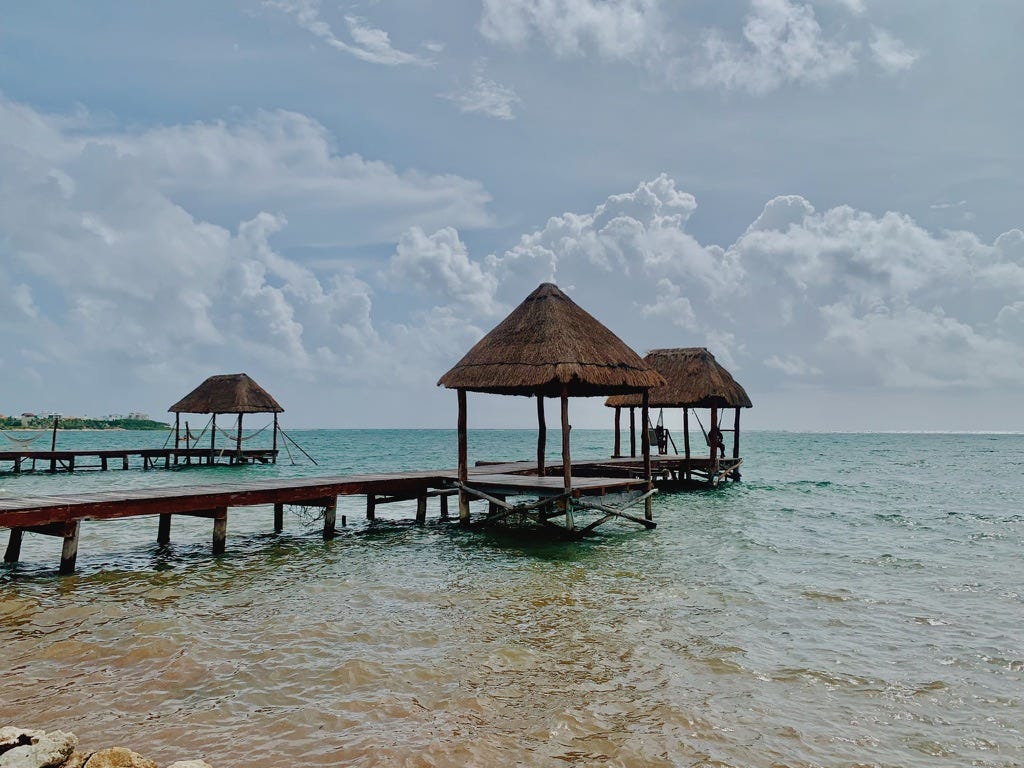
This lead photo is both deceptive and representative of my time in Tulum all at once – I had a brilliant time settled on a quieter stretch of beach in northern Tulum, and here I am in bliss but this beach is the majority of where I spent my time…
So here I am to discuss the troubles with Tulum (and other rapidly expanding tourist hubs in the center of a chaotic, complex drug trade).
First we need to rewind: In the 1970s, the Mexican government poured money into Cancun to develop a “multimillion dollar playground” that permitted flocks of U.S. tourists to visit annually (pre-pandemic levels recorded over 20 million visitors per year to the Mexican Caribbean, which includes both Cancun and Tulum). An idyllic combination of white sand, beachfront, lush jungle, historic ruins (Chichen Itza being the most famous of the 50+ Mayan ruins in the region), and proximity to the U.S., it was no surprise that word spread like wildfire and Cancun was bought up, and built up, rapidly.
Soon after, developers looked further south of Cancun–80 miles south to be exact–setting their sites on Tulum. Though Tulum became the new hotspot for property owners promised “an up and coming destination,” in the 80s and 90s, it experienced its most prominent boom in the 2000s when tourists were seeking more of a laid back, “off-the-beaten-path” Mexican itinerary. And a decade later, the blessing and curse of Instagram truly resulted in an explosion in popularity surrounding Tulum. Mitchell Friedman reports in his article for Tablet Hotels, “a study cited Tulum’s growth in population from 92 people in 1960 to 2,000 [people] by 1990, before rocketing to 12,000 in the year 2000.” And that doesn’t account for the tourists.
◇ ◇ ◇
In 2019, Mexico welcomed about 97 million visitors, of which 26 percent of those accounted for trips to Cancun, 22 percent for trips to the Riviera Maya (Tulum, Playa del Carmen) and not even a close third, Mexico City accounted for 9.2 percent of tourists.
During my trip, I talked to my tour guide about this rapid development and he seemed both proud and conflicted with how Tulum was developing. There’s construction everywhere which has of course pushed the locals out, and with the influx of tourists, has come the dangerous increase in crime, with about a dozen gangs fighting over street-level drug sales in Tulum.
The day after I arrived in Tulum, tourists were warned to stay put in their hotels following a deadly shooting, which was an unfortunately timed example of this drug-fueled violence. The shooting attracted international headlines as two foreign tourists were killed in the crossfire, including a California-Indian blogger and German tourist, and three foreigners were injured. It prompted international foreign offices to issue travel advisories about avoiding Tulum, and if you were in Tulum, to “not leave your secured hotel facilities.”
It eventually came out that the shootout was sparked by two groups fighting for street-level drug sales and the tourists, who were dining nearby, were caught in the crossfire. The gang was reportedly part of the Gulf Cartel, who extended operations from Cancun to Tulum; warning signs were posted by the cartel, reading “we are in control here.”
With so many of my friends traveling to Tulum, not to mention bloggers, journalists and influencers I follow, I never witnessed this dark side from their sunny posts and vibrant nights out on the town. This led me to believe that the shooting was a freak accident. However, the more I read up, the more I realized the recurring–and slightly overlooked–problem. According to statistics from Mexico’s national system of public security, murders increased by 80.5 percent between January and September 2021, from the same period last year (65 murders were registered during the 2021 period, while 36 murders were registered in 2020).
I put up a story on my Instagram that day to let friends and family know I was safe, but more importantly to draw attention to the matter I’d never seen or heard talked about in my travel community. I also felt grateful I had a gorgeous resort to shelter in (that was also safe) so I could still enjoy Tulum’s bounty of nature. But when I left Tulum, I knew I wanted to research, and share, more beyond an Instagram story that would disappear into the internet’s universal oblivion. It is a greatly complicated issue to talk about when you’re not on the ground there experiencing the day-to-day but I'm hoping by sparking this conversation, it will encourage you to pursue your own research.
For the 10, 15, or 20 of my friends who’ve visited, they may have never posted about this darkness not because they wanted it to look like they had a paradisal vacation, but because they didn’t experience something of this magnitude during their trip. And truthfully to say, if I wasn’t there for this shooting, I likely wouldn’t be writing about it today. These are the realities of travel, and what makes travel so subjective.
◇ ◇ ◇
All of this to say is, if you’re considering a destination such as Tulum, or any other area that’s previously been flagged for violence by your foreign travel department (in the U.S. it’s the Dept of State Bureau of Consular Affairs), familiarize yourself with recent trends, happenings or events that may add risk to a vacation you’re taking as a reward. Since I am already talking about Tulum–I promise I am not picking apart this destination as there are others but since I haven’t visited firsthand, I don’t feel comfortable adding them to this conversation–here are a few articles about the recent struggle with cartels, as well as their history:
How Dangerous is Tulum for Tourists Right Now?
Violence Is Rising Rapidly in Mexico’s Tourist Jewel on The Caribbean
For a more general and detailed overview of Mexico’s drug crime: Global Conflict Tracker: Criminal Violence in Mexico
While I know this email wasn’t the most sunshine-y to read, I hope it’s at least been enlightening. My hope isn’t for you to cancel an upcoming trip to Tulum if you have one planned, nor to write off the destination completely, and my hope isn’t for you to live in fear; my hope is that you learned something about travel and the way certain destinations are portrayed. There’s turmoil not just in Tulum, but in our backyards. If these numbers and statistics were startling to you, the best thing you can do to learn more about the issues is research, from your hometown to the country of your next trip.
On another note, I did say in my previous email to you that this Tulum trip was the perfect storm, and that’s because on top of this headlining news–and on a more materialistic side of the trip–I fell sick to food poisoning. This is another unpleasant side to travel that I certainly haven’t discussed–namely, because I hadn’t experienced it before. This was my first brush with food poisoning!
I’m not going to get into the details here but it was horrible and painful and scary to fall sick in a foreign country. I simultaneously wanted the comforts of my own bed and the luxury of ordering Uber-Eats Gatorade, yet without leaving the bed I was in at that moment. It's also since changed the way I travel and look at certain foods because I'm still wary of feeling that sick again, especially in a foreign country.
All of this was a reminder to never get too comfortable no matter how many countries you have, or have yet, to visit.
No traveler is immune to the darker side of travel–and both examples I highlighted in this newsletter only scratch the surface of the darker side to travel–a genre many of us, especially luxury travelers, tend to overlook.
It was also a reminder to enjoy the moments that you can, when you can.
When we were told to stay at the hotel, we succumbed to a lazier itinerary than planned, and it was glorious–reading and lounging in hammocks, drinking one too many margaritas (pre-food poisoning!), frolicking in the clear Caribbean Sea–it would have been difficult to complain. And when I look back at this trip, that’s what I feel: gratitude. For the experiences all around and, now, gratitude for you, for allowing me to share this raw experience.
While I won't be running back to Tulum anytime soon, I do look forward to the day I visit again because if I can leave you with one final lesson that travel's so insistently taught is you can't judge a destination by one visit alone.
Some recent articles:
The Coziest New England Hotels with Fireplaces
BlockBar Launches NFT Gifting with 300 Bottles of Rare Penfolds Wine
Lambrusco, Baga Espumante and Other Sparkling Red Wines from Around The World
Xo,
J